
The Three-Point Support System of the Jaw

The lower jaw—also called the mandible—is uniquely connected to the head in two key areas: the right and left temporomandibular joints (TMJs) as well as occlusal contacts b/w upper and lower teeth. Each TMJ is formed by the condyle of the mandible sitting within the articulating fossa at the base of the skull. Together, these joints allow the jaw to open, close, and move in multiple directions. In addition to these joint connections, the mandible interacts with the upper jaw through interocclusal contacts—where the teeth meet along the dental arches. Proper coordination between the TMJs and the bite is essential for smooth jaw movement, balanced chewing function, and long-term oral health.
For the lower jaw to remain stable—and for all articulating surfaces to stay healthy without wear, attrition, deformation, chipping, or fracturing—two key elements must be in harmony: the TMJs and the teeth. Both the joints and the interocclusal contacts must be as stable and well-balanced as possible. When these systems work together smoothly, they protect one another, support efficient function, and help maintain long-term oral and joint health.
Inside each TMJ, the rounded head of the condyle is most stable when it rests securely in the concave depression of the articular disc. This disc, in turn, fits snugly within the articulating fossa at the base of the skull. When all three components—the condyle, disc, and fossa—are properly aligned, the joint operates smoothly, distributes forces evenly, and remains protected from wear or injury.
Tooth contacts between the upper and lower jaws are considered stable when the teeth meet evenly and with the greatest possible surface area. In a well-balanced bite, each tooth is positioned securely against its opposing partner, creating broad, stable contact. This allows the entire dental arch to share chewing forces evenly, no matter where the bite pressure occurs. Ideally, the right and left sides should balance each other, with occlusal forces distributed approximately 50/50. When this balance is achieved, the teeth, muscles, and joints all function more efficiently and with less risk of wear or injury.

Finding True Stability
When the joints and teeth are fully stabilized, any jaw movement will consistently guide the teeth back into the same, precise contact position. This repeatable position represents a normal, physiologic, and highly predictable occlusion—one in which no traumatic forces occur. Achieving this stable bite protects the teeth, joints, and muscles, and it also ensures the longevity of natural tooth structure as well as dental restorations.
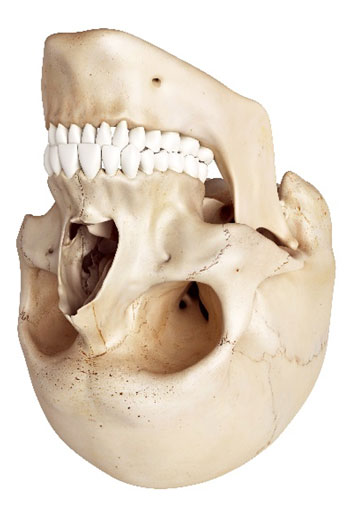
Now, imagine taking the skull with the lower jaw attached and flipping it upside down. When we look at the skull in this upside-down position, it appears as though the teeth of the lower jaw are “seated” on the teeth of the upper jaw. At the same time, the two condyles resemble legs standing firmly on the base of the skull. In this orientation, the jaw looks as if it is resting on two stable supports—the condyles—while the teeth are comfortably seated against their upper counterparts.
Now imagine removing one of these three points of support and trying to keep the jaw “seated” in this unstable position. For example, if the teeth are no longer resting evenly against each other, the “legs”—the condyles—must work much harder to maintain balance. As a result, the surrounding muscles are forced to overwork in order to stabilize the jaw. This constant effort leads to muscle strain, tightness, and eventually spasm.
If we take this idea further, the imbalance becomes even more pronounced when the “bench” is only partially available. Imagine trying to sit on just half—or even a third—of the bench. The support is minimal, unstable, and unreliable. In this scenario, the “legs” (the condyles and their supporting muscles) must bear an enormous amount of stress to keep the jaw in position. Now picture maintaining this strained posture not just for minutes, but for days, weeks, months, or even years. The constant overload leads to fatigue, discomfort, and eventually significant dysfunction in the muscles and joints. Conversely, when the “legs” cannot find proper support, the seating portion of the jaw—the occluding teeth—must absorb excessive stress as they struggle to provide balance and stability. Instead of sharing forces evenly, the teeth become overloaded as they take on the responsibility of supporting and steadying the jaw. Over time, this imbalance leads to wear, fractures, mobility, sensitivity, and deterioration of both the teeth and the supporting structures.
A Stable Bite: The Foundation of a Healthy Jaw
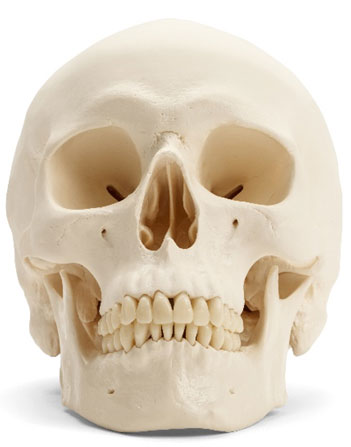
Now let’s look at this again: to maintain even, physiologic force distribution within the entire stomatognathic system—and to prevent any one part from being overworked or overstressed—a stable balance between the occlusion and the condyles must be achieved. When the bite and the joints are aligned and functioning harmoniously, the system operates efficiently, predictably, and without trauma. This stability protects the teeth, the TMJs, and the muscles, ensuring long-term comfort, health, and durability of oral structures and dental restorations.